Category: Cargo Visibility

  • Temperature and Humidity Monitoring in Pharma

    Temperature and Humidity Monitoring in Pharma

    A pharmaceutical shipment does not need to arrive warm to fail. A few hours at the wrong humidity level, an unnoticed freezer excursion, or a warehouse zone with poor airflow can compromise product stability long before anyone sees visible signs of damage. That is why temperature and humidity monitoring in pharmaceutical industry operations is not a side task for QA or logistics. It is a control point.

    For companies moving high-value, time-sensitive, or regulated products, environmental monitoring is tied directly to product integrity, release confidence, and financial risk. If the data is late, incomplete, or trapped in disconnected systems, teams are left reacting after exposure has already happened. The real objective is not simply to record conditions. It is to detect risk early enough to act.

    Why temperature and humidity monitoring in pharmaceutical industry matters

    Pharmaceutical products live within narrow tolerances. Some require refrigerated handling, others must stay frozen, and many room-temperature products still have strict storage specifications. Humidity can be just as critical, especially for powders, capsules, biologics, active ingredients, and packaging materials that degrade or change performance when exposed to excess moisture.

    The stakes are high because the impact is not limited to one pallet or one route. A single environmental breach can trigger investigations, quarantine, batch rejection, delayed release, customer disputes, and regulatory scrutiny. When products move through multiple handoffs – manufacturing, storage, cross-docking, air freight, final distribution – every transfer introduces another chance for loss of control.

    This is where monitoring shifts from compliance documentation to operational intelligence. A data logger that confirms a problem after delivery has some value. A connected monitoring system that flags an excursion in transit gives teams a chance to intervene before the shipment becomes unusable.

    Compliance is only the starting line

    Most pharmaceutical organizations already understand the regulatory pressure around storage and transport conditions. Good Distribution Practice, Good Manufacturing Practice, validation requirements, audit readiness, and customer quality agreements all push toward documented environmental control.

    But compliance alone does not protect cargo. A company can technically collect temperature records and still miss the bigger operational problem if alerts arrive too late, devices fail in the field, or data cannot be matched to specific handling events. Passing an audit and preventing a loss are related goals, but they are not identical.

    The strongest monitoring programs are built to answer practical questions fast. When did the excursion begin? Where did it happen? Was the shipment on the tarmac, in a trailer, at a warehouse door, or delayed at a checkpoint? How long was the exposure? Which units were affected? Can the product still be released? If those answers take days to assemble, the monitoring program is not giving the business enough control.

    Temperature is visible. Humidity risk is often missed.

    Temperature gets most of the attention because it is easy to explain and often required on shipping documents. Humidity is more likely to become a hidden source of instability. That is especially true in mixed-mode logistics where cargo moves between climate zones, refrigerated spaces, and uncontrolled dwell points.

    Condensation risk is one example. A shipment can move from cold storage into a humid environment and create moisture exposure that affects labels, cartons, secondary packaging, and in some cases product quality. In other situations, sustained dry conditions can also create issues depending on the formulation and packaging configuration. The right threshold depends on the product, the route, and the packaging design. There is no universal number that works for every pharmaceutical load.

    This is why combined sensing matters. Temperature without humidity leaves a blind spot. And humidity without location context can make the data hard to use. Teams need to know not only what happened, but where and when it happened.

    What effective monitoring looks like in practice

    The best programs are designed around visibility, speed, and evidence. They do not stop at placing a logger in a box and downloading a report at destination. They create a chain of environmental intelligence from origin to delivery.

    That usually starts with selecting the right sensor format for the shipment profile. A disposable smart label may fit high-volume parcel distribution. A portable multi-sensor device may be better for reusable lanes, active interventions, or multimodal freight. The decision depends on shipment value, route complexity, expected transit time, and how quickly the team needs to respond if conditions drift.

    Placement matters as much as sensor choice. A device near the outer wall of a container may show different conditions than one placed near the product core. Neither reading is automatically wrong. They answer different questions. One may show ambient exposure risk, while the other reflects product-protective packaging performance. Serious programs account for this rather than treating one sensor reading as the whole story.

    Real-time connectivity changes the operating model. Instead of discovering a problem after arrival, teams can receive alerts during transit, escalate to the carrier, redirect a shipment, or prioritize handling on arrival. That response window is where value is created. For critical pharmaceutical loads, delayed information is often the same as no control.

    Monitoring across the full supply chain

    Pharmaceutical risk does not sit in one facility. It moves.

    A controlled warehouse can still hand off to an exposed loading area. A validated shipper can still sit too long before aircraft loading. A reefer can still lose power. Final-mile distribution can still become the weakest link, especially when products move through partner networks with uneven processes.

    That is why isolated monitoring points are no longer enough. Environmental control has to extend across storage, staging, transit, transfer, and delivery. A connected approach lets teams compare conditions across each leg and identify repeat failure points. If one airport, lane, carrier partner, or facility consistently creates excursions, the data should make that pattern obvious.

    This is also where integrated visibility becomes more valuable than standalone sensing. When temperature and humidity data sit beside location, light exposure, motion, and tamper events, the root cause becomes clearer. A spike in temperature means more when it lines up with a prolonged stop. A humidity change paired with a door-open event tells a more complete story than an isolated graph.

    Trade-offs that operations teams should weigh

    More data is not automatically better. Monitoring needs to fit the risk and the decision path.

    For lower-value products on stable domestic lanes, a simple validated logger may be enough if response in transit is not realistic. For high-value therapies, biologics, clinical materials, or global shipments with multiple handoffs, real-time connected monitoring is often the stronger choice because intervention can prevent much larger losses.

    There is also a balance between cost per shipment and consequence of failure. Some teams try to reduce monitoring expense by limiting devices or collecting data only on exceptions. That can work in mature, low-variance lanes. It becomes risky when routes change, volumes scale, or control depends on third parties. If the cost of a missed excursion includes rejected product, replacement shipments, and customer impact, the economics can shift quickly.

    False alarms are another practical issue. If alert thresholds are poorly configured, teams stop trusting notifications. Threshold design should reflect product stability, packaging performance, route conditions, and escalation responsibilities. Useful alerting is specific enough to trigger action but disciplined enough to avoid noise.

    Turning data into action

    A monitoring program succeeds when it changes decisions, not when it generates attractive dashboards.

    That means alerts should route to the people who can actually intervene. Quality needs defensible records. Logistics needs live exception visibility. Customer service may need delivery validation. Procurement and carrier management may need trend data for performance reviews. When environmental data is isolated inside one department, the business loses speed.

    This is where platforms matter. Devices collect the signal, but the platform turns those signals into operational command. Teams should be able to see shipment condition, location, and alert status in one place, investigate exceptions quickly, and retain records for audits and claims. For companies running sensitive cargo at scale, disconnected spreadsheets and manual downloads do not hold up for long.

    Blac approaches this as an end-to-end visibility problem, not just a tracking problem. That distinction matters in pharmaceutical logistics because the goal is not simply to know where cargo is. It is to know whether cargo is still safe to use.

    Building a stronger monitoring strategy

    If your operation is reassessing environmental control, start with the points where visibility breaks. Look at handoffs, dwell times, lane variability, and shipments where claims, investigations, or release questions keep appearing. Those are usually the areas where better temperature and humidity intelligence pays off first.

    Then align the monitoring method to the consequence of failure. Not every shipment needs the same device, reporting interval, or escalation workflow. But every critical shipment needs a level of visibility that matches its risk.

    Pharmaceutical logistics rewards control, not assumptions. When temperature and humidity are monitored in real time, tied to location and shipment events, and visible to the teams responsible for action, companies move from documenting exposure to preventing it. That shift protects product, strengthens compliance, and gives operations something more valuable than a report after the fact. It gives them time to respond.

  • Bluetooth Labels for Shipment Control

    Bluetooth Labels for Shipment Control

    A shipment leaves the dock in spec and arrives rejected. The product did not fail on the production line. It failed somewhere in transit, and nobody can prove exactly when. That is where bluetooth labels change the conversation. They give logistics teams direct visibility into shipment condition and handling while cargo is moving, not days later when a claim is already underway.

    For operations leaders, that matters because a label is no longer just an identifier. It becomes a source of evidence. Temperature drift, shock exposure, light events, route deviations, unauthorized opening, and dwell time can all leave a trace when the right wireless label is attached to the load. Instead of relying on assumptions, teams can work from shipment-level intelligence.

    What bluetooth labels actually do

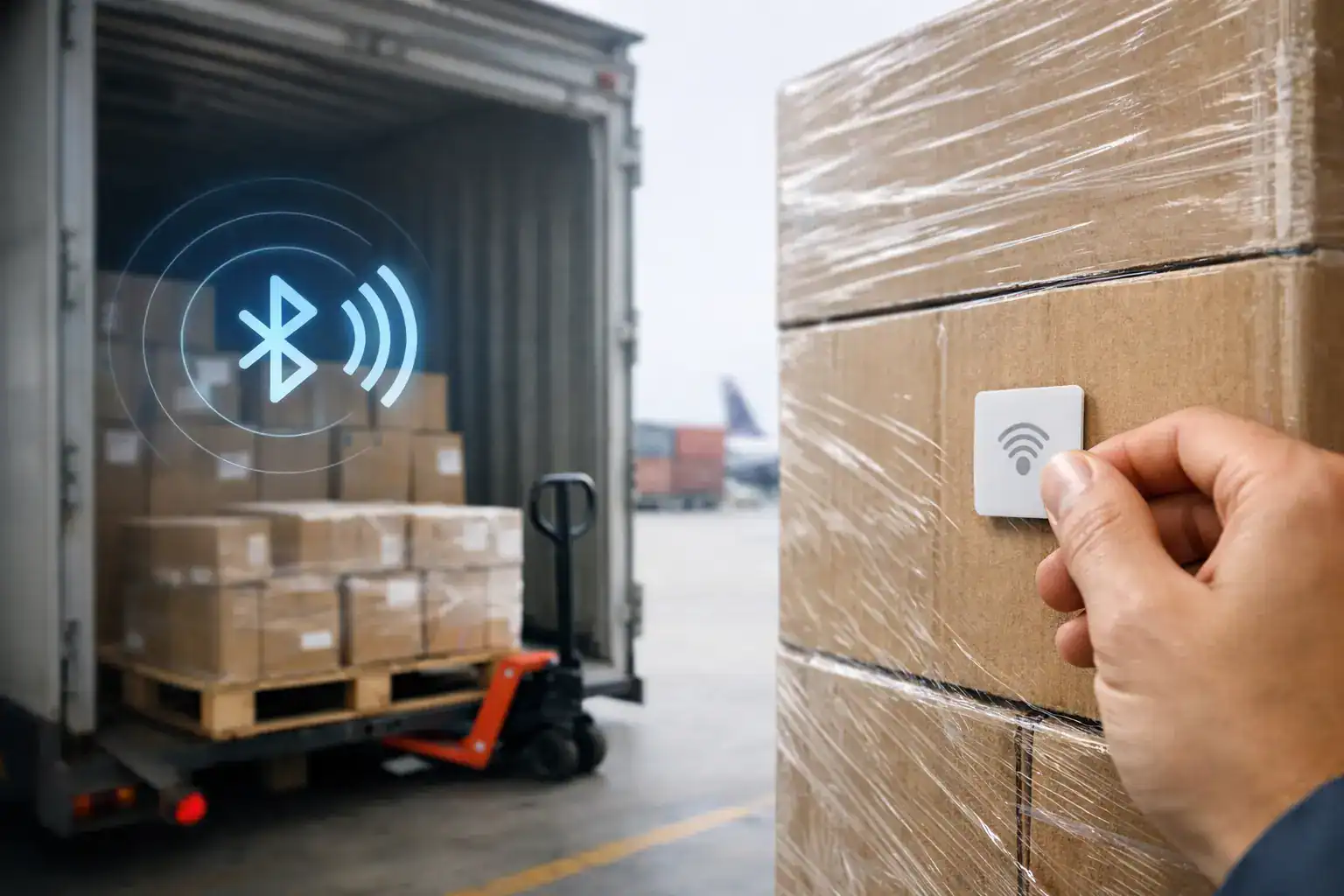
    Bluetooth labels are compact wireless devices designed to travel with freight, cartons, pallets, or individual assets. At a basic level, they broadcast data that can be collected by nearby phones, gateways, readers, or connected infrastructure. In logistics, that usually means a label can report where a shipment was seen, what conditions it experienced, and whether an exception occurred.

    The value depends on the label design. Some bluetooth labels are simple beacons built for proximity and identification. Others include sensors for temperature, humidity, light, vibration, or tamper detection. In higher-control environments, bluetooth is only one part of the visibility stack. The label captures local data, while a broader system moves that data into a platform where operations teams can review events, trigger alerts, and validate delivery conditions.

    That distinction matters. A bluetooth label by itself does not solve cargo risk. It solves part of the data collection problem. If your team needs real-time intervention across long trade lanes, you also need connectivity, software, and workflows that turn sensor events into action.

    Why bluetooth labels are gaining traction in logistics

    The appeal is straightforward. Bluetooth labels are small, flexible, and easier to deploy than many traditional tracking devices. They can be applied closer to the product, placed on secondary packaging, or used on shipments where a larger hard-case tracker is impractical. That makes them useful for high-volume operations that need more than spot checks but cannot justify heavy hardware on every move.

    They are also well suited to environments where condition matters as much as location. Cold chain operators, pharmaceutical shippers, food distributors, and teams moving high-value electronics all face the same operational problem: a shipment can appear delivered on time and still be compromised. Bluetooth labels help close that gap by recording what happened between origin and destination.

    Another factor is cost control. Not every shipment requires satellite-grade tracking or a reusable device with extended battery life. Sometimes the right decision is a lower-profile label that captures the key events needed for compliance, quality assurance, and dispute resolution. The best programs match the device to the risk profile of the cargo instead of over-instrumenting every lane.

    Where bluetooth labels fit best

    Bluetooth labels perform best when companies need scalable visibility at the shipment level. They are particularly effective on palletized goods, case-level monitoring, temperature-sensitive products, and short-to-medium duration shipments where checkpoints exist along the route.

    They also work well in facilities that already have phones, tablets, dock infrastructure, or gateway coverage. In those settings, labels can be read without adding much process friction. A warehouse scan, handoff point, or delivery confirmation can become a data capture event with very little extra labor.

    That said, performance depends on how the network is designed. Bluetooth is a short-range technology. If there are no readers, phones, or connected bridge devices nearby, the label may continue logging data but will not provide live updates on its own. For some operations, that is acceptable. For others, especially those managing high-value or highly sensitive freight, delayed visibility is not enough.

    The trade-off between simple logging and real-time control

    This is where many buying decisions go wrong. Teams hear “bluetooth labels” and assume they are buying real-time shipment visibility. In practice, there are two very different use cases.

    The first is logging. The label records conditions during transit, and the data is reviewed at checkpoints or destination. This is useful for quality audits, root-cause analysis, and delivery validation. It is a step up from passive indicators because it provides granular evidence instead of a yes-or-no breach signal.

    The second is active exception management. In this model, bluetooth labels are part of a connected system that surfaces alerts while the shipment is still moving. That can support intervention, such as rerouting cargo, contacting a carrier, inspecting a compromised load, or escalating a potential theft event before the shipment disappears.

    Both models have value. The right choice depends on what failure costs you. If the main goal is post-delivery proof, a logging approach may be enough. If the goal is preventing spoilage, reducing theft exposure, or protecting service-level commitments, you need a broader architecture built for live response.

    What to evaluate before choosing bluetooth labels

    Sensor coverage should come first. If your losses are tied to temperature abuse, impact, unauthorized opening, or humidity drift, the label needs to measure those conditions reliably. Buying a wireless label with the wrong sensor profile only creates more blind spots.

    Battery performance matters next, but not in isolation. A long battery life sounds attractive, yet it means little if the device cannot maintain reliable reporting throughout the shipment cycle. Consider actual trip duration, storage time before use, read frequency, and environmental extremes.

    Data access is another deciding factor. Some bluetooth labels are easy to deploy but difficult to operationalize because the information stays fragmented across apps, scans, or local reads. Logistics teams need a clear chain of custody for the data. They need timestamps, event history, and a platform that turns exceptions into workflows.

    Integration should not be treated as a later-phase problem. If shipment intelligence cannot be pushed into existing operational processes, alerts stay stuck in dashboards and teams revert to manual follow-up. The value comes when data from the label supports claims management, QA review, customer communication, and carrier performance analysis.

    Finally, think about disposal, reuse, and deployment scale. A reusable device may lower cost over time on closed-loop routes. A disposable or single-use smart label may be more practical for global distribution, one-way freight, or high-volume programs where retrieval is unrealistic.

    Bluetooth labels and chain-of-custody proof

    One of the strongest use cases for bluetooth labels is delivery validation. In many disputes, the critical question is not whether the shipment arrived. It is whether it arrived in the right condition, with the right handling, and without unauthorized access.

    A connected label can help establish that record. If a pallet experienced repeated shock, if a carton was opened in transit, or if temperature moved outside tolerance for a defined period, the event trail becomes part of the shipment history. That strengthens internal accountability and gives customer-facing teams better evidence when issues arise.

    This is especially important for regulated goods and customer-sensitive shipments. A signed proof of delivery does not confirm cargo integrity. Sensor-based proof comes much closer.

    Why bluetooth labels are not enough on their own

    For high-stakes freight, labels must be part of a control strategy, not a stand-alone purchase. The device is only one layer. The larger requirement is end-to-end visibility that combines sensing, connectivity, alerting, and a system for response.

    That is why many enterprises move beyond a single hardware decision and evaluate the full visibility stack. A provider such as Blac approaches this as an operational control problem: devices that detect shipment events, connectivity that moves data off the cargo, and a platform that gives teams immediate insight into location, condition, and risk. That model is more useful than buying labels in isolation and trying to build response workflows later.

    The operational question is simple. When an excursion happens, who knows, how fast do they know, and what can they do next? If bluetooth labels cannot support that answer, the program is incomplete.

    The real business case for bluetooth labels

    The return is not just fewer lost shipments. It shows up in reduced spoilage, better carrier accountability, faster investigations, cleaner claims documentation, lower manual inspection effort, and stronger customer confidence. It also helps teams identify where process failure actually occurs – during loading, at a transfer point, in storage, or on final delivery.

    That level of detail changes decision-making. Instead of treating cargo risk as a broad carrier issue, teams can target the specific lanes, facilities, and handoffs causing damage or delay. Over time, that leads to tighter SOPs and better network performance.

    Bluetooth labels are not a cure-all. Some shipments need cellular devices, GPS coverage, or multilayer sensing. Some lanes can function with simple data logging. The right answer depends on cargo value, trip duration, exception cost, and how quickly your team needs to act.

    But one thing is clear: when a shipment matters, visibility at the label level is no longer optional. The companies that perform best are the ones that can detect what is happening in transit and respond before a minor exception becomes a rejected delivery, a lost customer, or a preventable claim.

    Take the label seriously. In the right system, it is not packaging. It is operational intelligence traveling with your cargo.

  • What a Tracking Label Should Really Do

    What a Tracking Label Should Really Do

    A pallet leaves the dock in spec and arrives rejected. The handoff looks normal on paper, but somewhere between departure and delivery, temperature drift, shock, or tampering changed the outcome. That is where a tracking label proves its value. It does not just tell you where a shipment is. It tells you what happened to it, when the risk started, and whether your team still has time to act.

    Why a tracking label matters now

    For logistics teams moving pharmaceuticals, perishables, electronics, and other sensitive freight, visibility gaps are expensive. A missed excursion can trigger claims, spoilage, regulatory issues, customer disputes, or repeat service failures. Basic tracking has never been enough for cargo that can be damaged without any visible sign on the outside.

    A tracking label closes that gap by turning each shipment into a live source of operational data. Location is part of the picture, but condition and event history are what make the data useful. If a shipment is delayed at a terminal, exposed to excessive heat on a tarmac, or opened unexpectedly in transit, the label creates a record your team can act on instead of a mystery they have to explain later.

    That difference matters because most cargo losses are not caused by one dramatic incident. They build quietly. A few hours outside temperature range. A hard impact during transfer. A route deviation that increases theft exposure. When you can see those issues while freight is still moving, you shift from post-mortem reporting to active control.

    What separates a tracking label from basic shipment tracking

    Many shipping operations already have carrier milestone updates, barcode scans, and transportation management data. Those systems help with planning and proof of movement, but they do not provide direct intelligence from the cargo itself. They tell you when a shipment was scanned, not whether it was protected.

    A true tracking label sits with the goods and reports from the shipment environment. Depending on the use case, that can include temperature, humidity, light exposure, vibration, tilt, tamper events, battery status, and movement data through cellular, GPS, or Wi-Fi signals. This gives operations teams a more reliable view of actual shipment conditions across road, air, rail, and ocean legs.

    That distinction is critical in high-stakes freight. A status update that says a load is on time does not help if the product is already compromised. A tracking label adds context to every movement event. It tells you whether the cargo remained within acceptable thresholds and whether the chain of custody stayed intact.

    The best tracking label is built for intervention, not just records

    A lot of shipment monitoring tools promise visibility. The real question is what kind of visibility they provide and whether it changes the outcome.

    A tracking label that only delivers data after arrival has value for root-cause analysis, claims support, and compliance records. For some lower-risk shipments, that may be enough. But for critical cargo, delayed data limits your options. By the time a receiver identifies a problem, the damage is done, replacement costs are rising, and customer confidence is already under pressure.

    The stronger model is real-time or near-real-time monitoring with alerts tied to specific thresholds. If a refrigerated shipment starts warming during a delay, your team can escalate before the excursion becomes a total loss. If light exposure indicates an unauthorized opening, security and operations can investigate while the shipment is still in transit. If repeated shocks occur during handling, you can identify the weak point in the network instead of blaming the final carrier by default.

    That is where a connected visibility stack matters. The label is the field device, but the business outcome depends on what surrounds it – connectivity, alert logic, software, and operational workflows. Hardware alone does not create control. Actionable intelligence does.

    Where tracking labels create the most value

    Not every shipment needs the same level of monitoring. The value of a tracking label rises with product sensitivity, customer expectations, and the cost of failure.

    Cold chain operations are an obvious fit because temperature excursions directly affect product quality and compliance. Pharmaceutical shipments, biologics, specialty foods, and fresh produce all depend on maintaining exact conditions across multiple handoffs. In those environments, a tracking label helps verify integrity and supports faster exception management.

    High-value cargo is another strong use case. Electronics, luxury goods, medical devices, and specialized components face elevated theft and tampering risk. Here, location and tamper intelligence work together. A route deviation may not look unusual in a general tracking system, but paired with an unexpected stop or opening event, it becomes a meaningful security signal.

    Industrial and manufacturing supply chains also benefit when downtime costs exceed freight costs. If a critical part is delayed or damaged in transit, the issue does not stop at one shipment. It can affect production schedules, service commitments, and revenue recognition. A tracking label gives supply chain teams earlier warning and more defensible delivery validation.

    What to look for in a tracking label program

    Choosing a tracking label should start with operational priorities, not device specs. The wrong question is whether the label has enough features. The right question is whether it helps your team prevent loss, verify outcomes, and respond fast enough to matter.

    Start with the sensing requirements. If your shipments are temperature-sensitive, precision and alert timing matter more than a long list of less relevant sensors. If theft prevention is the priority, location fidelity, geofence logic, and tamper detection deserve more attention. For fragile goods, shock and vibration data may be the deciding factor.

    Next, consider the network reality. Multimodal freight moves through warehouses, ports, aircraft, trucks, and remote areas with variable coverage. A tracking label must be reliable across those transitions. Global shipping programs especially need flexible connectivity and a platform that handles signal gaps without losing the shipment story.

    Battery life, form factor, and deployment model also matter. Some teams need a disposable smart label for scale and simplicity. Others need reusable devices for higher-value lanes. There is no universal best option. It depends on shipment volume, recovery processes, route length, and how much intervention value each shipment justifies.

    Finally, look beyond the device. Data without workflow is noise. Alerts should go to the right teams, at the right threshold, with enough context to trigger a decision. If the system creates more dashboards than action, it adds overhead instead of control.

    The trade-off between cost and coverage

    Every monitoring strategy involves trade-offs. Full real-time visibility on every shipment sounds attractive, but it is not always necessary or cost-effective. A smarter approach is to align tracking label deployment with risk.

    Some businesses start by instrumenting critical SKUs, high-claim lanes, new carriers, or sensitive customer accounts. That creates immediate value and builds a case for broader adoption. Others use labels selectively for audits, lane qualification, or seasonal risk periods when excursion rates tend to rise.

    What matters is not using a tracking label everywhere. What matters is using it where uncertainty is most expensive. If one rejected shipment can erase the margin from dozens of successful deliveries, added visibility is not a technology upgrade. It is risk control.

    Why data credibility matters as much as data access

    When a shipment is disputed, the quality of your data becomes operational leverage. Can you show the exact time conditions changed? Can you prove whether the product remained within range? Can you confirm whether the shipment was opened before delivery? A credible tracking label creates defensible shipment history.

    That matters internally and externally. Quality teams need records they can trust. Logistics teams need evidence for carrier reviews and process correction. Customer-facing teams need confidence when validating a delivery or responding to a complaint. Without reliable shipment-level data, every exception turns into an argument.

    This is one reason many shippers are moving away from isolated devices toward integrated visibility programs. A standalone tracker may capture events, but a connected system organizes those events into usable intelligence. That is the difference between collecting data and controlling outcomes.

    Blac approaches this problem as an end-to-end visibility task, not a single-device decision. For operators responsible for sensitive freight, that matters because visibility only works when devices, connectivity, platform logic, and response workflows operate together.

    The shift from tracking freight to controlling freight

    The phrase tracking label can sound simple, almost administrative. In modern logistics, it is not. It is a control point attached directly to the shipment. It verifies location, monitors condition, records exceptions, and gives your team a chance to intervene before small failures become expensive ones.

    The businesses that get the most value from a tracking label are not chasing more data for its own sake. They are reducing blind spots, protecting customer commitments, and making every handoff easier to verify. When cargo quality, compliance, and service reliability are on the line, that level of control is no longer optional. It is how disciplined supply chains stay ahead of avoidable loss.

  • Global Traceability Solutions Guide

    Global Traceability Solutions Guide

    A shipment leaves the warehouse in spec and arrives rejected. The paperwork says it moved on time. The carrier says it was handled correctly. The customer shares photos of damage, temperature deviation, or tamper signs – and now your team is left reconstructing what happened from fragments.

    That is where a global traceability solutions guide becomes useful. Not as a theoretical framework, but as an operating lens for companies that need proof, intervention, and control across complex freight networks. If you manage pharmaceuticals, perishables, high-value cargo, or any shipment where a single blind spot can turn into a claim, service failure, or compliance problem, traceability is no longer a reporting function. It is a live control system.

    What global traceability solutions actually need to solve

    Traceability is often reduced to knowing where a shipment is. That is too narrow for modern logistics. Location matters, but location without condition data can still leave you exposed. A pallet can be on the right route and still be unusable because it was exposed to heat, light, shock, or unauthorized access.

    Effective traceability solves three operational questions at the same time. Where is the cargo now? What has happened to it in transit? What needs attention before the issue reaches the consignee? If your system cannot answer all three, your team is still managing exceptions after the fact.

    This is why many legacy tracking setups fall short. A simple carrier milestone feed may confirm departure, customs clearance, and delivery. It rarely explains whether product integrity held throughout the journey. In high-stakes shipping environments, visibility has to extend beyond milestones into shipment condition, handling events, and risk signals that support action.

    The core components in a global traceability solutions guide

    A practical global traceability solutions guide starts with architecture, not marketing claims. Most platforms sound capable until you test them against real operating conditions across road, air, sea, and rail.

    The first requirement is connected sensing at the shipment level. That means smart labels, disposable devices, or reusable monitors that travel with the cargo and collect the data that matters – temperature, humidity, light, vibration, battery status, and tamper-related events. If the device only reports location, you are only seeing part of the problem.

    The second requirement is dependable connectivity. Global freight does not move through one network environment. It crosses facilities, ports, aircraft, distribution centers, rural corridors, and border points. Traceability systems need to maintain reporting through cellular, GPS, and Wi-Fi logic that fits the route and the shipping mode. If data only appears at the start and finish, the operational value drops fast.

    The third requirement is a platform that turns raw data into usable oversight. Teams do not need more dashboards for the sake of dashboards. They need a control layer that shows shipment status, highlights exceptions, validates delivery conditions, and supports rapid escalation. A platform should reduce investigation time, not create another stream of information to monitor manually.

    The fourth requirement is operational support at scale. This point gets missed. Devices, connectivity, and software only work as a traceability solution when deployment is manageable. If your team cannot activate devices quickly, assign them to shipments, define alert thresholds, and recover data without friction, adoption stalls. Good traceability is not just technical. It is executable.

    Why real-time visibility changes the economics of risk

    Most cargo losses do not become expensive because the event happened. They become expensive because nobody saw the event early enough to respond.

    A cold chain excursion that is detected hours after arrival often leads to spoilage, disputes, and replacement costs. The same excursion, detected in transit, may allow rerouting, intervention, or preemptive customer communication. A suspected tamper event discovered at the destination can trigger claims and reputational damage. The same event, flagged in real time, can initiate a security response while the shipment is still recoverable.

    This is the real value of traceability. It compresses the time between incident and decision. That changes the cost curve. Instead of documenting failure, your team gets a chance to contain it.

    For logistics leaders, this also improves accountability. When shipment records include route history, environmental data, handling events, and delivery condition evidence, disputes become easier to resolve. You spend less time arguing over assumptions and more time acting on facts.

    How to evaluate traceability tools without getting distracted

    Many buyers start with a feature checklist. That is reasonable, but not enough. The better approach is to evaluate solutions against the actual points where your operation loses control.

    Start with shipment criticality. If you are moving low-risk goods with wide tolerance ranges, basic visibility may be enough. If you are shipping biologics, fresh food, electronics, or luxury items, condition monitoring and tamper awareness move to the center of the buying decision. The right solution depends on the cost of failure, not just the cost of the device.

    Next, look at route complexity. Global trade lanes introduce handoffs, dwell time, customs delays, and network variability. A system that performs well on domestic parcel flows may not hold up across multimodal freight with long transit windows. Ask whether the solution can sustain visibility during the exact types of journeys you run.

    Then assess exception management. Alerts are only useful if they are configurable and operationally relevant. Too many notifications create noise. Too few leave you exposed. Good systems let teams define thresholds by product, route, or customer requirement so that intervention is targeted rather than reactive.

    Finally, examine evidence quality. Can the system validate that cargo arrived within required conditions? Can it document when and where a problem began? Can quality, operations, and customer teams all work from the same shipment record? Traceability has the most value when it supports not just transport monitoring, but downstream resolution and compliance.

    Where companies often make the wrong choice

    One common mistake is buying a tracker instead of a traceability system. A tracker can show movement. A traceability system should show movement, condition, and risk in one operational view. If your team has to combine device data, carrier updates, spreadsheets, and customer complaints just to understand one incident, the stack is still fragmented.

    Another mistake is overengineering the deployment. Some organizations choose solutions that look powerful in a pilot but become hard to scale across sites, lanes, or partners. If the setup is too complex for warehouse teams, carriers, or customer-facing staff, consistency breaks down. The strongest solution is the one your operation can run every day, not the one that looks impressive in a demo.

    There is also a trade-off between granularity and practicality. More data is not always better. The right question is whether the data changes decisions. For some cargo, frequent location pings and basic condition checks are enough. For sensitive products, denser monitoring may be justified. The system should match the risk profile instead of applying one monitoring standard to everything.

    What strong execution looks like

    Strong execution starts before the shipment moves. Teams define what must be monitored, what thresholds matter, who receives alerts, and what action follows each exception type. That sounds simple, but it is the difference between collecting telemetry and managing outcomes.

    During transit, the best operations work from live status rather than waiting for a customer complaint or a carrier update. If there is a temperature rise, unexpected light exposure, route deviation, or impact event, the team sees it in time to investigate. That creates a tighter feedback loop between operations, quality, and customer service.

    After delivery, traceability becomes evidence. You can validate chain of custody, confirm arrival conditions, and shorten claims handling. For companies under compliance pressure, this record is not just useful. It is protection.

    This is where an integrated approach stands out. Blacsol focuses on the full visibility stack – connected devices, sensing, connectivity, software, and operational support – because isolated tools rarely give logistics teams enough control when shipments are exposed to real-world disruption.

    The future of traceability is operational, not theoretical

    The market is moving away from passive shipment monitoring and toward active exception control. That shift matters because customer expectations, product sensitivity, and supply chain volatility are all increasing at the same time. Knowing what happened after delivery will not be enough for long.

    The companies that perform better will be the ones that treat traceability as part of day-to-day execution. They will use live shipment intelligence to protect cargo, validate service, and reduce avoidable loss across global networks. They will also recognize that the best solution is not the one with the longest spec sheet. It is the one that gives teams clear visibility, credible evidence, and time to act when conditions change.

    If you are reviewing your options, keep the standard simple. Choose the system that helps your team detect risk before the shipment becomes a problem someone else has to explain.

  • Stickers That Do More Than Mark a Box

    Stickers That Do More Than Mark a Box

    Stickers That Do More Than Mark a Box

    A sticker used to mean one thing in logistics: a label to identify a box, route a pallet, or flag special handling. That is no longer enough. In high-value, time-sensitive supply chains, Stickers are starting to serve a different role – not just marking freight, but monitoring it.

    For operations teams under pressure to reduce loss, prove compliance, and respond faster to in-transit issues, that shift matters. A passive label cannot tell you if a shipment was exposed to heat, opened without authorization, dropped during transfer, or delivered to the wrong place. A smart sticker can.

    Why stickers matter in modern logistics

    The value of a sticker in freight has always been simplicity. It is easy to apply, low profile, and scalable across large shipment volumes. That is exactly why the category is becoming more important, not less. When intelligence is built into the same lightweight format, the sticker stops being packaging support and starts becoming an operational control point.

    This is especially relevant for shipments where product condition matters as much as arrival. Pharmaceuticals, biologics, food, electronics, and other sensitive cargo can be compromised long before anyone notices. If the only record you have is a barcode scan at origin and destination, you are managing risk with blind spots in between.

    Smart stickers close that gap. They combine shipment identification with sensor-based monitoring and connectivity, giving logistics teams direct visibility into where cargo is and what happened to it during transit.

    What smart stickers actually do

    Not all stickers belong in the same category. A standard shipping label carries static data. A condition indicator may show that a threshold was crossed, but often only after delivery. A connected smart sticker goes further by collecting data during the trip and making it available while the shipment is still moving.

    Depending on the device, that can include temperature, humidity, light exposure, vibration, battery status, tamper events, cellular location, GPS position, and Wi-Fi-based tracking support. That combination changes how teams manage freight.

    Instead of asking, “Did something go wrong?” after a customer complaint, teams can ask, “What is happening right now, and do we need to intervene?”

    That distinction is operationally significant. Real-time or near-real-time visibility supports exception management, not just post-mortem reporting. If a cold chain shipment starts drifting out of range, a team can escalate before product quality is lost. If a tamper event occurs during a handoff, security teams can act while the trail is still fresh. If vibration exposure spikes on a fragile load, downstream inspection can be prioritized before delivery is accepted.

    Where stickers fit best

    Smart stickers are not the answer for every shipment. That is one of the most important decisions to get right.

    For reusable assets, long-haul containers, or high-power tracking needs, a portable or hard-mounted device may be the better fit. Those formats can offer longer battery life, stronger mounting, and expanded sensing options. But when operations need a low-profile, shipment-level device that can scale across cartons, cases, or one-way freight, stickers have a clear advantage.

    They work well when ease of deployment matters. Teams do not want a solution that slows packing lines, requires reverse logistics, or creates extra handling steps at destination. A sticker format keeps adoption practical. It can be applied quickly, used once, and tied directly to a shipment record in the visibility platform.

    That makes stickers particularly effective for parcel flows, cold chain packaging, trial shipments, premium SKUs, and lanes with recurring claims or theft exposure.

    The trade-off: simple form, serious expectations

    The appeal of stickers is obvious, but expectations need to stay grounded in the shipment profile.

    A sticker-sized device operates under tighter physical constraints than a larger tracker. Battery size, transmission frequency, environmental exposure, and trip duration all affect performance. A short domestic parcel move and a long multimodal international shipment place very different demands on the device.

    That is why the sticker itself is only part of the decision. The real question is whether the full system around it supports operational control. Data without alerting creates noise. Alerts without context create confusion. Hardware without reliable connectivity leaves the same blind spots in place, just with more complexity.

    This is where an end-to-end approach matters. Devices, connectivity, sensor logic, and platform workflows need to work together so teams can detect potential damage before it reaches the customer, validate handling conditions, and respond with confidence.

    Smart Stickers as a control layer

    For logistics leaders, the best use of smart stickers is not novelty. It is control.

    Control over condition compliance. Control over theft and tamper detection. Control over proof of delivery and chain-of-custody validation. Control over exceptions before they become claims, write-offs, or service failures.

    In that sense, stickers are no longer just an accessory to the shipment. They are becoming part of the intelligence layer around it. Blac Smart Sticker and Smart Sticker Pro reflect that shift by turning a familiar format into a real-time source of shipment evidence.

    If a shipment is valuable enough to monitor, it is worth asking whether a sticker should only identify the box – or help protect what is inside.


    Blacsol Enterprises LLC

    101 E Park Blvd, Ste 413 Plano, Texas.

    Blac©, All rights reserved.

  • Temperature and Humidity Monitoring System

    Temperature and Humidity Monitoring System

    A missed temperature excursion rarely starts as a major incident. More often, it begins as a small blind spot – a reefer door left open too long, a pallet staged on a hot dock, a route delay that pushes sensitive freight past its safe threshold. By the time the problem is visible at delivery, the loss has already happened. A temperature and humidity monitoring system closes that gap by turning cargo conditions into live operational intelligence.

    For shippers moving pharmaceuticals, food, electronics, chemicals, or other high-value goods, temperature and humidity are not secondary data points. They are direct indicators of product integrity, compliance exposure, customer satisfaction, and claims risk. If your team cannot verify what happened in transit, you are left making decisions after the fact. That is expensive, slow, and difficult to defend.

    What a temperature and humidity monitoring system actually does

    At its core, a temperature and humidity monitoring system measures environmental conditions around cargo and delivers that data in a way your team can use. The difference between basic monitoring and operational control is timing. A logger that only reveals a temperature failure after arrival can document the problem. It cannot help you prevent it.

    A modern system should capture readings throughout transit, transmit data while the shipment is moving, and trigger alerts when conditions drift outside acceptable ranges. In logistics, that matters because the value is not just in recording history. The value is in giving operations teams a chance to intervene before product quality is compromised.

    That intervention may be simple. A carrier can be contacted. A shipment can be rerouted. A facility can prepare for expedited handling. A customer service team can communicate early instead of reacting under pressure. The point is control. Data without response capability is only partial visibility.

    Why temperature alone is not enough

    Many supply chains still focus on temperature as the primary indicator of risk. That makes sense for cold chain operations, but it is not the full picture. Humidity can be just as damaging, depending on the cargo.

    Excess moisture can degrade packaging, affect labels, damage electronics, encourage mold growth, and alter the condition of pharmaceuticals and food products. Low humidity also creates issues in certain cases, particularly for materials sensitive to drying, static, or brittleness. If your monitoring strategy only tracks one variable, your risk model is incomplete.

    This is where a combined temperature and humidity monitoring system becomes more than a compliance tool. It becomes a way to understand the environment your goods actually experienced. That matters when disputes arise, when spoilage patterns repeat, or when one lane consistently underperforms despite appearing acceptable on paper.

    The operational value of real-time monitoring

    Real-time visibility changes how logistics teams work. It moves condition monitoring from passive documentation to active exception management.

    When condition data is available during transit, teams can prioritize attention based on actual risk instead of assumptions. A delayed shipment carrying shelf-stable goods may not require immediate escalation. A delayed shipment carrying humidity-sensitive product during a heat wave probably does. Without live data, both incidents may look similar in a transport management system. With live data, the difference is clear.

    This is especially valuable across multimodal shipments, where custody changes and transit delays create natural blind spots. Road, air, ocean, and warehouse handoffs introduce new exposure points. Every handoff increases the chance that a small environmental issue becomes a larger loss event. Monitoring systems reduce uncertainty by maintaining continuity across those transitions.

    For high-stakes cargo, that continuity supports more than internal decision-making. It strengthens delivery validation, supports quality reviews, and gives commercial teams stronger evidence when customers or partners question shipment condition.

    What to look for in a temperature and humidity monitoring system

    Not every system is designed for real logistics pressure. Some are built for static storage environments. Others are fine for internal audits but too limited for in-transit use. The right choice depends on your cargo profile, your service levels, and how quickly your team needs to act.

    Start with data availability. If you need to prevent excursions, not just document them, the system must provide access to readings before delivery. Next, look at alerting. Raw data is useful, but operations teams need threshold-based notifications that tell them when action is required.

    Sensor accuracy also matters, but accuracy alone is not enough. A precise reading that arrives too late has limited operational value. Connectivity matters just as much. In global freight, shipments move through areas with uneven network coverage, so the system needs a reliable way to store and forward data when connections drop.

    Battery life, device form factor, and deployment speed should also be considered. A bulky device may be fine for reusable programs but impractical for disposable or one-way shipments. A system that takes too much labor to configure may look good in a pilot and fail at scale.

    Finally, the platform matters. Teams do not need more disconnected dashboards. They need one place to see location, condition, alert history, and shipment context together. This is where an end-to-end visibility stack has an advantage over a standalone sensor. When temperature and humidity data are paired with location, light exposure, vibration, battery status, and tamper events, the investigation becomes faster and the response becomes more precise.

    Where businesses usually get it wrong

    The biggest mistake is treating monitoring as a checkbox. If the goal is only to prove that a shipment failed, the system may satisfy an audit requirement while doing little to reduce losses.

    Another common issue is overengineering the rollout. Some organizations spend months debating ideal thresholds, device types, and reporting structures without addressing the practical question of how exceptions will be handled once alerts start coming in. Monitoring only works when someone owns the response.

    There is also a trade-off between coverage and depth. A company may choose to monitor only premium shipments with advanced devices, or it may deploy broader coverage with simpler sensors across more lanes. Neither approach is automatically right. It depends on product value, claim frequency, regulatory exposure, and customer expectations. The best programs usually start by identifying where the cost of not knowing is highest.

    Carrier cooperation is another variable. A monitoring system can surface risk, but intervention depends on operating relationships and escalation processes. If your team cannot reach the right partner quickly, real-time alerts lose some of their value. Technology improves control, but it does not replace process discipline.

    Why this matters for compliance and customer trust

    Condition-sensitive cargo moves under increasing scrutiny. Customers expect proof. Regulators expect traceability. Internal quality teams expect defensible records. A temperature and humidity monitoring system helps meet those demands, but its real value is broader than compliance.

    It gives your business a stronger position when shipments are challenged. Instead of relying on assumptions, your team can review timestamps, thresholds, route events, and condition history. That shortens investigations and improves confidence in release, rejection, or claim decisions.

    It also protects customer relationships. If a shipment arrives in question and you have no condition record, the conversation starts with uncertainty. If you can show exactly what happened in transit, the conversation becomes factual. That difference matters, especially when the cargo is expensive, regulated, or urgently needed.

    For companies scaling across regions or trade lanes, consistency becomes another advantage. Standardized monitoring creates a clearer operating model across carriers, modes, and facilities. That reduces dependency on anecdotal reporting and gives leadership a cleaner view of where risk is concentrated.

    From monitoring to control

    A temperature and humidity monitoring system is not just a sensor program. It is part of a broader control strategy for cargo integrity. The strongest deployments connect condition monitoring to alert workflows, shipment visibility, and post-delivery validation so teams can detect issues early and respond with confidence.

    That is where companies like Blac bring practical value. When connected devices, live sensing, and a self-service visibility platform work together, operations teams gain more than readings. They gain command over exceptions that would otherwise stay hidden until delivery.

    The goal is not to collect more data for its own sake. The goal is to reduce avoidable loss, protect service performance, and make shipment decisions with evidence instead of guesswork. If your freight is sensitive to environmental conditions, every unmonitored mile is a risk decision whether you intended it or not. The right system gives that decision back to your team, where it belongs.

  • Smart Stickers BLE for Cargo Visibility

    Smart Stickers BLE for Cargo Visibility

    A missed temperature excursion rarely starts as a major loss. More often, it begins as a short blind spot between handoffs, a trailer door left open too long, or a shipment that sat in the wrong zone without anyone knowing. That is where smart stickers BLE become operationally valuable. They give logistics teams a practical way to extend visibility closer to the carton, pallet, or parcel level without adding the cost and complexity of a full tracker on every unit.

    For shippers moving pharmaceuticals, perishables, electronics, and other sensitive cargo, that matters. The challenge is not just knowing where freight should be. It is knowing what happened to it, when conditions changed, and whether the shipment remained within acceptable thresholds as it moved through warehouses, yards, cross-docks, and final-mile environments.

    What smart stickers BLE actually do

    Smart stickers BLE are thin, connected sensor labels that use Bluetooth Low Energy to record and transmit shipment data. In practical terms, they are designed to attach directly to cargo and monitor conditions such as temperature, humidity, light exposure, shock, or motion, depending on the device configuration.

    Their value comes from proximity-based intelligence. Rather than relying only on a large tracking unit mounted to a container or trailer, BLE stickers sit much closer to the goods themselves. That creates a more accurate picture of what the product experienced, especially when cargo inside the same shipment can be exposed to different conditions.

    Bluetooth Low Energy also changes the deployment equation. These devices are smaller, lighter, and often more cost-effective than heavier reusable hardware. For many operations, that makes them easier to scale across higher shipment volumes, shorter routes, or lower-margin lanes where full telematics on every load may not be realistic.

    Why BLE stickers fit modern logistics operations

    Visibility programs often stall for a simple reason: the cost per shipment is too high to support broad rollout. A company may have excellent monitoring on premium lanes and almost no insight everywhere else. That gap creates risk.

    Smart stickers BLE help close it. They allow teams to expand monitoring across more shipments, more SKUs, and more handoff points. For operations dealing with mixed freight profiles, this is especially useful. A high-value biologic shipment may justify a fully connected tracker with cellular and GPS, while a regional shipment of temperature-sensitive food may need a lighter, lower-cost device that still proves compliance and flags exceptions.

    This is where trade-offs matter. BLE is not a universal replacement for cellular tracking. It is a different layer of visibility. A BLE sticker typically depends on a nearby gateway, phone, reader, or integrated infrastructure to upload data in real time. If your route has strong gateway coverage, BLE can be highly effective. If cargo moves through remote segments without any collection point, data may be stored locally until the shipment reaches a readable location.

    For some operations, that is enough. For others, especially those managing theft exposure or high-value international freight, delayed transmission may not support the level of intervention required. The right choice depends on the shipment risk, the speed of response needed, and the network available along the route.

    Where smart stickers BLE create the most control

    The strongest use case for smart stickers BLE is not simply tracking for the sake of tracking. It is exception detection close to the product.

    In cold chain logistics, the sticker can verify whether product-level temperature stayed within tolerance during loading, staging, and delivery. In quality-sensitive distribution, it can help confirm that a package was not exposed to excess humidity or an unauthorized opening event. In damage prevention programs, it can record shock or tilt activity that points to mishandling during transit.

    That level of detail changes how teams respond. Instead of disputing a customer complaint with limited evidence, operations can review shipment data tied to a specific unit. Instead of assuming damage happened somewhere in the network, they can narrow the event window. Instead of finding out after delivery, they can set alerts and act earlier when the infrastructure supports real-time reads.

    This is also why BLE stickers matter in multimodal freight. Every transfer point introduces uncertainty. Warehouses, ports, airport handling zones, and local delivery hubs all create moments where shipment condition can shift quickly. A sensor sticker attached to the cargo provides continuity through those transitions, even when the transport asset changes.

    Smart stickers BLE vs. larger connected trackers

    The comparison should not be framed as one technology winning over another. In most serious supply chain programs, the better model is layered visibility.

    Larger connected trackers are stronger when you need continuous wide-area location updates, route monitoring, and active in-transit intervention. They are better suited for trailer-level visibility, theft prevention, and international lanes where GPS and cellular coverage support persistent oversight.

    Smart stickers BLE are stronger when the priority is scalable sensing at the cargo level. They work well for shipment condition validation, proof of handling compliance, and broader deployment across many packages or pallets. They are also useful in programs where a reusable gateway or portable device collects data from multiple BLE stickers in the same shipment or facility.

    The trade-off is straightforward. Larger trackers provide stronger standalone connectivity. BLE stickers provide greater density and lower deployment friction. If you need both operational command and product-level evidence, combining technologies is often the most effective approach.

    What to evaluate before deployment

    Not every BLE sticker program delivers the same business result. The hardware matters, but the operating model matters just as much.

    First, look at the sensing requirement. A shipment that only needs temperature logging is different from one that needs light, tamper, vibration, and humidity monitoring. The closer the sensor profile matches the actual risk profile, the more useful the data becomes.

    Second, look at how data will be collected. If your facilities, vehicles, or field teams already have phones, gateways, or readers available, BLE deployment is easier. If not, you need a clear process for when and where data is captured. Without that, devices may gather information but fail to support timely decision-making.

    Third, consider the workflow after an alert. Visibility is only valuable if someone can act on it. If a sticker detects an excursion, who gets notified, how quickly can they investigate, and what authority do they have to intervene? The operational response plan should be defined before devices go live.

    Fourth, think about scale. Pilots often perform well in controlled conditions, then struggle once they expand across carriers, distribution centers, and international handoffs. Battery life, sticker durability, onboarding speed, and data consistency all become more important at volume.

    This is why many logistics teams now favor end-to-end visibility systems over isolated sensors. The device is only one part of the control stack. You also need connectivity, software, alerts, reporting, and support that fit the realities of freight operations. That is the difference between collecting data and actually reducing loss.

    The business case is speed, proof, and prevention

    When teams evaluate smart stickers BLE, the first question is often cost. The better question is what blind spots are currently costing you.

    If product claims are rising, if spoilage is difficult to trace, or if customers are challenging delivery quality, cargo-level visibility can pay back quickly. The savings do not come only from prevented loss. They also come from faster investigations, fewer manual checks, stronger compliance records, and better service recovery when incidents occur.

    There is also a customer trust angle. When you can validate that a shipment remained within required conditions, you reduce disputes and strengthen confidence in your operation. For industries with strict quality expectations, that proof has direct commercial value.

    Companies like Blacsol are building around this reality. The market no longer needs disconnected tracking tools that leave operators to piece together hardware, connectivity, and reporting on their own. It needs visibility systems that help teams detect potential damage before it reaches the customer and act with confidence while freight is still moving.

    Where BLE stickers fit next

    As supply chains push for broader traceability, smart stickers BLE are likely to become more common at the shipment edge. Not because they replace every other device, but because they make granular sensing more practical across larger networks.

    That shift favors operators who think in layers. Use the right device for the right risk. Put cargo-level sensing where product integrity matters most. Pair it with the data collection and alerting structure required to make the information useful. And judge the technology by one standard only: whether it improves control when the shipment is exposed to real operational pressure.

    If a sticker can help your team see a problem sooner, prove what happened, and protect the next shipment from the same failure, it is doing far more than tracking. It is helping you run a tighter supply chain.

  • Disposable GPS for Smarter Shipment Control

    Disposable GPS for Smarter Shipment Control

    A shipment does not become low risk just because it left on time. Once cargo moves beyond the dock, blind spots start to cost money. Disposable GPS closes that gap by giving logistics teams shipment-level location intelligence without the operational burden of device retrieval, redeployment, and reverse logistics.

    For teams moving pharmaceuticals, perishables, electronics, or other sensitive freight, that difference matters. The question is not simply whether a tracker can report a dot on a map. The question is whether it can support control at scale, across real shipping conditions, with enough context to validate delivery, detect route deviations, and act before a delay becomes a claim.

    What disposable GPS actually solves

    Traditional reusable trackers can work well in closed loops where assets return predictably. Many supply chains do not operate that way. Freight crosses regions, changes hands, moves through third-party networks, and often ends at locations that are not set up to collect and ship tracking hardware back.

    That is where disposable GPS becomes operationally valuable. Instead of treating visibility as a recoverable hardware exercise, it treats visibility as a shipment-level requirement. A tracker is applied to the load, travels with it, reports throughout the journey, and is disposed of at the end of its useful life. That model reduces friction in one-way shipments, international lanes, sample distribution, parcel-scale monitoring, and programs where labor at destination is limited.

    The business case is usually straightforward. If retrieving hardware costs more than the hardware itself, or if recovery rates are inconsistent enough to weaken the program, disposable devices are often the better fit. They simplify deployment and remove a common failure point from visibility strategy.

    Disposable GPS is not just about location

    Location alone rarely explains what happened to a shipment. A truck can arrive at the correct destination and still deliver compromised goods. A container can remain on route and still sit too long on a hot tarmac. A pallet can appear on time but show signs of tampering, excessive vibration, or a door-open event at the wrong moment.

    That is why the strongest disposable GPS solutions are tied to broader sensing and alerting. In practice, logistics teams need more than position pings. They need context. Temperature, humidity, light exposure, motion, battery status, and tamper events help turn raw movement data into operational intelligence.

    This is especially relevant in high-stakes shipping environments. For cold chain freight, a location update is useful, but a location update paired with a temperature excursion is actionable. For high-value cargo, a route deviation matters more when it is matched with an unexpected stop or light event. Visibility becomes more than tracking. It becomes evidence.

    Where disposable GPS fits best

    Not every shipment needs a disposable tracking device. Applying them to every lane without segmentation can increase costs without improving outcomes. The right approach is to match the tool to the risk profile.

    Disposable GPS tends to deliver the strongest value in one-way distribution networks, cross-border shipments, last-mile delivery of critical inventory, temporary monitoring programs, and high-loss or high-claim lanes. It also makes sense when customer experience depends on documented proof of handling, arrival, or condition.

    Pharmaceutical shipments are an obvious use case because route validation and environmental monitoring often support compliance, quality assurance, and chain-of-custody requirements. Perishable foods and biologics also benefit because delays and environmental deviations can quickly affect product integrity. Electronics, luxury goods, and high-theft categories use disposable trackers to improve recovery chances and strengthen exception investigations.

    There is also a practical use case in pilot programs. Teams testing a lane, carrier, region, or packaging configuration may need quick visibility without setting up a reusable-device return workflow first. Disposable GPS allows a faster start with less process overhead.

    The trade-off: convenience versus depth of deployment

    Disposable devices remove recovery complexity, but that does not mean every disposable GPS option is equal. Some are built for basic breadcrumb tracking. Others are designed for more demanding, real-time operational oversight.

    Battery life is one factor. A device intended for a short domestic route may not be suitable for ocean freight, airport dwell time, and final-mile delivery combined. Reporting frequency also matters. Frequent updates create stronger control, but they consume more power. That trade-off has to match transit duration and risk level.

    Connectivity is another differentiator. A tracker that performs well in one region may struggle across global trade lanes if it lacks the right cellular profile or fallback logic. The same is true for indoor transitions and warehouse handoffs, where GPS signals alone can become unreliable. In those cases, blended location approaches using cellular and Wi-Fi intelligence can improve consistency.

    Then there is data usability. A disposable GPS device is only as valuable as the platform behind it. If the team cannot configure alerts, review route history, investigate exceptions, or export evidence quickly, the device becomes a passive logger instead of an operational tool.

    What logistics teams should evaluate before rollout

    A successful deployment starts with the business objective, not the hardware spec sheet. Some teams need theft deterrence. Others need delivery validation, claims reduction, temperature oversight, or customer-facing proof of performance. Those goals affect everything from sensor selection to reporting cadence.

    It is worth asking a few direct questions early. Does the shipment require real-time updates or is periodic reporting enough? Is the lane domestic, international, or multimodal? Will the device be exposed to refrigerated environments, handling shock, or long dwell times? Who receives alerts, and what action are they expected to take when one appears?

    This is where many programs either gain traction or stall. If alerts are too frequent, teams ignore them. If they arrive too late, the operational window is gone. If the data sits outside daily workflows, it becomes interesting but not useful. The strongest implementations connect shipment intelligence to clear escalation paths.

    For that reason, device, connectivity, software, and support should be evaluated together. A shipment visibility program does not succeed because a tracker transmits. It succeeds because exceptions are detected early and the organization knows what to do next.

    Why disposable GPS supports scale better than many expect

    There is a common assumption that disposable devices are only a lightweight option for basic monitoring. In reality, they can be a strong choice for scaling visibility across broad shipment volumes, especially when reverse logistics creates cost or compliance issues.

    Reusable programs often look efficient on paper. Then the hidden work appears. Devices are not returned. Batteries need servicing. Teams spend time cleaning, testing, reassigning, and reconciling inventory. Destination partners may not participate consistently. Each missed return weakens utilization and inflates true program cost.

    Disposable GPS removes much of that drag. Deployment becomes simpler for origin teams, destination sites have fewer responsibilities, and visibility can be extended to lanes that would otherwise remain uncovered. For organizations trying to standardize oversight across many trading partners, that simplicity has real value.

    That does not mean disposable should replace reusable in every case. Closed-loop operations, dedicated fleets, and recurring asset movements may still favor reusable devices. The better view is that both models have a place. The right mix depends on lane structure, asset return reliability, shipment value, and operational tolerance for complexity.

    From tracking to intervention

    The biggest mistake companies make with disposable GPS is treating it as a passive audit tool. If the data is reviewed only after delivery, the company gains hindsight but loses the chance to prevent loss.

    Real value comes from intervention. When a shipment sits outside a geofenced route, someone should know. When temperature begins drifting toward an excursion threshold, someone should have time to escalate. When a high-value load stops in an unauthorized area, the system should trigger immediate review.

    That is where an end-to-end visibility approach matters. The device generates the signal, but the platform turns it into an alert, a workflow, and a defensible record. For supply chain leaders under pressure to reduce claims, improve service reliability, and protect cargo in motion, that difference is substantial.

    Solutions such as those offered by Blac are built around that model – connected hardware, shipment intelligence, and operational response working together instead of in isolation. That matters because risk does not arrive as a hardware problem. It arrives as a business problem.

    Choosing disposable GPS with the right expectations

    Disposable GPS is not a magic fix for every weak point in transport execution. It will not solve poor carrier management, weak packaging, or unclear escalation ownership. What it does provide is a sharper line of sight into what is happening between departure and delivery.

    For many logistics teams, that line of sight is enough to change outcomes. It improves proof. It narrows disputes. It exposes recurring lane issues. It gives quality, security, and operations teams a shared version of the truth. And when shipments are too critical to move on assumption alone, that visibility becomes part of control.

    If a shipment is valuable enough to monitor, it is valuable enough to monitor in a way that fits the lane, the risk, and the operational reality. Disposable GPS works best when it is chosen for that reason – not as a gadget, but as a practical control point inside a serious visibility strategy.

    The smartest tracking decision is usually the one that removes friction without giving up oversight.